Restoration Guide
IICRC Standards Explained: S500, S520 & S700
By Water Damage Restoration Sahuarita · 2026-10-14 · Sahuarita, AZ
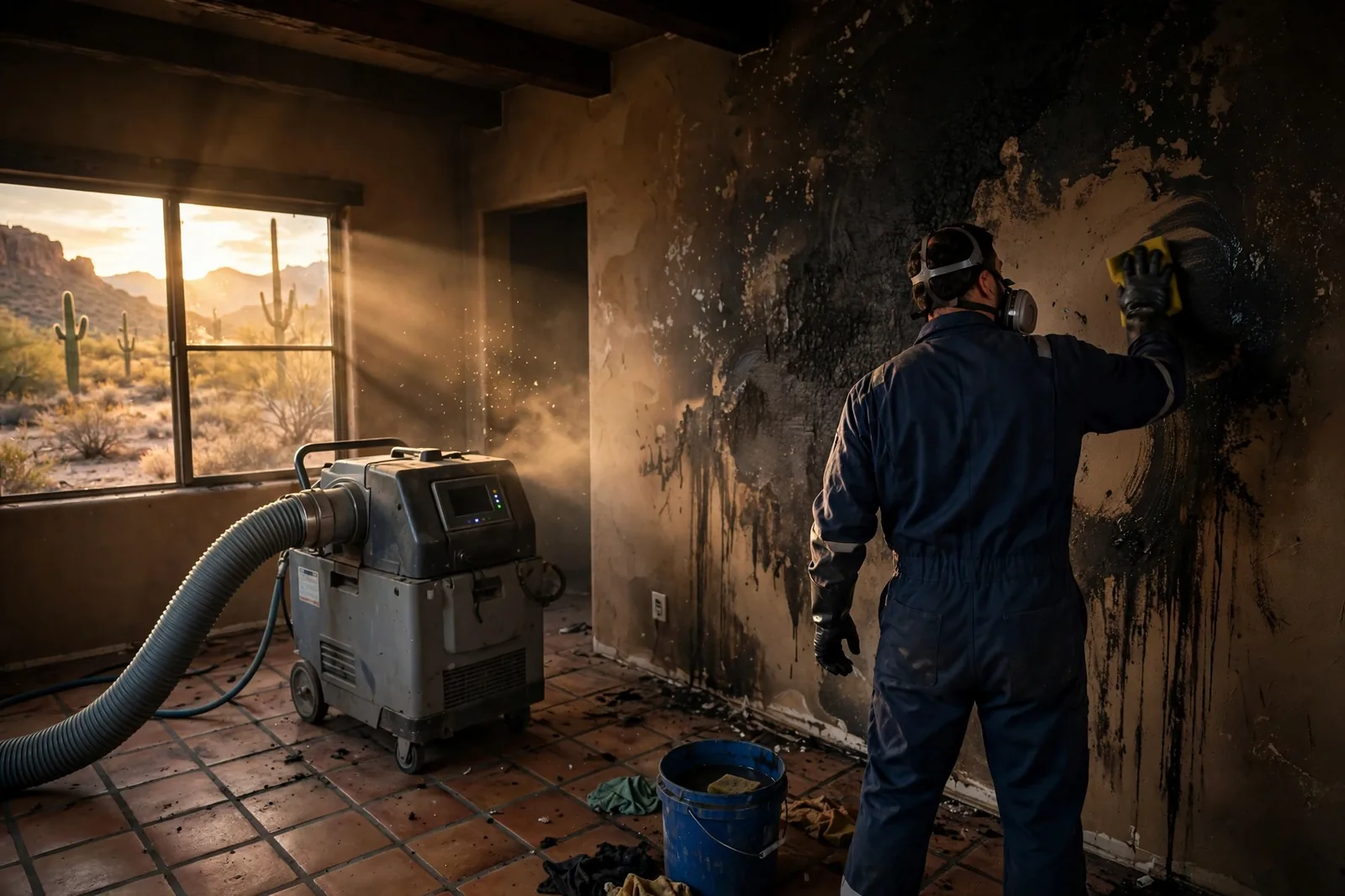
If you read restoration estimates, insurance scopes, or contractor websites, three numbers come up again and again: S500, S520, and S700. These are the IICRC standards for water damage, mold, and fire and smoke restoration. Most homeowners have never read them, and most contractors will never hand you a copy.
This guide explains what each standard actually covers, what it means for your job, and what to ask any restoration contractor. It does not claim any credential for us. Standards are a yardstick, not a sales pitch, and the yardstick only matters if you know how to use it.
What IICRC standards are (and are not)
The IICRC, the Institute of Inspection, Cleaning and Restoration Certification, publishes standards that describe how restoration work should be done. A standard is a consensus document: a committee of professionals writes it, the public reviews it, and the published version becomes the reference point for the trade.
A standard is not a law, not a license, and not a guarantee. It describes the process that gives the best chance of a good outcome, and it tells you what to measure along the way. When a contractor says they follow a standard, the question to ask is: how does your process map to it, and what documentation proves it?
- Consensus standards: written by industry committees, published for public review
- They describe accepted practice, not a promise of results
- They are referenced by insurers, adjusters, and contractors nationwide
- They tell you what to measure, not just what to do
S500: water damage
S500 is the standard for water damage restoration. It defines water categories, from Category 1 clean water to Category 3 black water, and classes of intrusion, from a small contained spill to a full-floor saturation. The category and class decide the process: what gets extracted, what gets removed, and what gets dried in place.
The core principle is measurement. Drying is not done when the carpet feels dry. It is done when moisture meters show the affected materials are back to dry standards. Any estimate that skips measurement is guessing.
- Water categories 1, 2, and 3: clean, gray, and black water
- Classes of water intrusion: how far the water spread and what it soaked
- Drying principles: extraction, evaporation, dehumidification, and verification
- Moisture measurement: the job is not dry until meters say it is
S520: mold
S520 is the standard for mold remediation. Its core principle is containment: the affected area is isolated with barriers and negative air pressure before work begins, so mold spores are not spread through the house during cleaning. Then moldy porous materials are removed, not just wiped.
S520 is also honest about limits. No honest contractor promises a mold-free home, because mold spores exist everywhere. The goal is to remove the growth and the moisture that fed it, and to verify that the indoor level is back to normal. Testing and clearance can confirm the result, and they are worth asking about when the job is large.
- Containment: isolate the affected area before work begins
- Removal, not just cleaning: moldy porous materials come out
- No promise of a mold-free home: mold is everywhere; the goal is a normal level
- Post-remediation verification: a check that the work achieved its goal
S700: fire and smoke
S700 is the standard for fire and smoke damage restoration. It covers soot removal, odor removal, contents restoration, and the sequence of work. Its most useful idea is that soot type matters: dry soot from a fast-burning fire, wet soot from a slow smolder, protein soot from a kitchen fire, and fuel-oil soot each behave differently and clean differently.
S700 also puts odor removal in its proper order: remove the source first, then treat what remains. A contractor who sprays deodorizer over soot-covered walls is skipping the standard, and the smell will come back.
- Soot types matter: dry soot, wet soot, protein soot, and fuel-oil soot clean differently
- Odor removal is a process, not a spray: source removal first, then treatment
- Contents: cleaning, storage, and restoration of belongings
- Documentation: photos and scope, tied to the damage found
What to ask any restoration contractor
Standards are only useful if you use them. Before you hire any restoration contractor, ask how their process maps to the standard for your type of damage, what they measure, and what documentation you receive. Ask what gets removed and what gets dried or cleaned in place, and why.
The answers tell you more than any credential. A contractor who can explain their process in plain language, tie it to a standard, and put it in a written scope is a contractor you can trust. A contractor who cannot is selling confidence, not restoration.
- How does your process map to the relevant standard?
- What do you measure, and what documentation do I get?
- What gets removed, what gets dried or cleaned in place, and why?
- How do you verify the job is done, not just finished?
- What is in the written scope, and what is not?
Frequently Asked Questions
Is IICRC a license or a law?
Does an insurer require IICRC standards?
What is the difference between S500 and S520?
Do standards guarantee the job is done right?
Who writes the standards?
Fire or smoke damage in Sahuarita?
Talk to a local restoration crew today, 24/7 emergency line.
24/7 emergency line, we answer around the clock.